Rethinking the Playbook

Updated: Dec 4, 2025
How Environmentalism Lost Its Spark–and What a New, Faster, Braver Model Could Look Like
The strangest thing about this moment in American environmental history is how predictable the response from big green NGOs has become. The second Trump administration is tearing through half a century of environmental protections with breathtaking speed: scrapping methane rules, shrinking monuments, gutting climate reviews, silencing scientific expertise. And yet the sector’s reflex remains the same. Issue a statement. Draft a brief. Send another fundraising email. It’s as if the house is burning and the fire department is calmly passing out pamphlets.
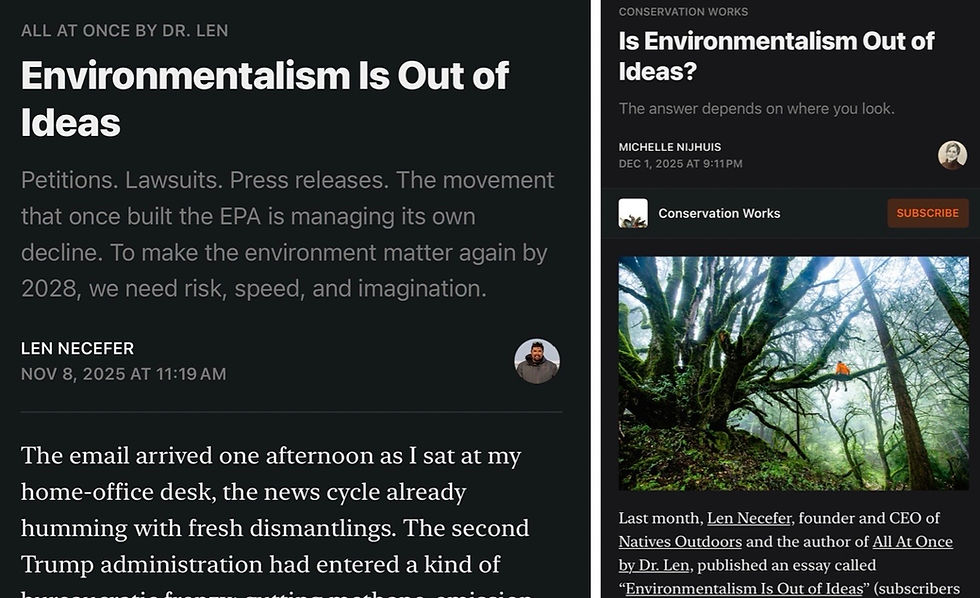
This is the tension at the core of two recent critiques of the movement. In Dr. Len Necefer’s viral Reddit essay Environmentalism Is Out of Ideas, it appears as the recognition that the old playbook simply cannot meet the urgency of the political moment. The environmental movement hasn’t stalled because people stopped caring; it has stalled because its institutions drifted into slow, sanitized, process-heavy patterns that no longer match the way ordinary people experience climate change. Creativity has been replaced by caution. Emotional resonance has been reshaped into messaging. Urgency has been swallowed by internal approval chains. What once acted like a movement now performs like a consultancy.
That same critique is echoed by author Michelle Nijhuis in her Substack essay Is Environmentalism Out of Ideas?, which argues that the problem is not just bureaucratic inertia but intellectual atrophy. The environmental sector continues to lean on decades-old strategies—technocratic fixes, market-friendly nudges, conflict-avoidant optimism, and the stubborn belief that “raising awareness” will save us, even though awareness is no longer the bottleneck. Nijhuis adds that while fear appeals once worked brilliantly, today they mostly reach an exhausted base, while new supporters aren’t apathetic—they simply don’t want more dread. Much of mainstream environmentalism feels disconnected from people’s daily realities: rising household costs, smoky summers, flood-prone neighborhoods, canceled insurance, and the slow erosion of familiar places. The result is a movement overflowing with information but starved for cultural heat.
After nearly forty years working across science, policy, community conservation, and education, we feel the truth of these critiques acutely. We've lived through the eras they describe: the hopeful expansions, the bureaucratic contractions, the moments when imagination surged, and the long stretches when it seemed to evaporate. Some of these criticisms land with force; some miss the mark; all of them demand a response. And part of that response, we believe, lies in building new spaces—like Ocean Hoptimism—that can meet this moment with the speed, humanity, and creative courage the movement has too often lost.
The Case for a New Model
Necefer’s proposal lands powerfully because it offers a way out of this institutional gravity. He invokes the WWII-era Lockheed “Skunk Works,” a small, deeply trusted team liberated from bureaucracy to move quickly, experiment boldly, and embrace risk without waiting for consensus to coagulate around the safest option. The suggestion is not that climate politics can mimic fighter-jet design, but that environmentalism needs an equivalent structure: small, nimble groups empowered to cultivate speed, imagination, and emotional clarity.
Nijhuis's critique adds that the movement’s challenge is not a lack of technical solutions but a collapse of narrative daring. It has lost the ability to tell stories that help people feel the future, lost the courage to lean into conflict, and grown so accustomed to incrementalism that real cultural intervention now feels outlandish. She argues that rebuilding momentum will require shifting persuasion downward to local groups whose place-specific credibility can translate environmental concerns into the health, safety, and affordability issues people already care about. Together, these critiques reveal a movement that excels at producing information but struggles to generate the public momentum that information arguably exists to spark.
Where the Essays Land Powerfully
Both essays succeed in naming something the movement has tiptoed around for years: climate communication has drifted into abstraction. The public does not experience climate in atmospheric parts-per-million or target lines on a graph; it experiences climate in the smoke that cancels recess, the bills that creep higher each summer, the shoreline that recedes with each king tide, the water advisory that comes without warning. Civic engagement grows not from technical precision but from emotional resonance, identity, and story. On this, the critiques are correct.
They also capture a deeper cultural mismatch. As Nijhuis writes, "the wealthiest environmental organizations in the U.S. are still relying on 'Silent Spring' persuasion tactics in a 'Braiding Sweetgrass' world.” The movement continues to rely on fear-based alerts, exposés, and scientific alarm at a time when people are increasingly moved by narratives of reciprocity, kinship, healing, and belonging. The culture has evolved toward relationship and meaning, while much of environmentalism remains anchored in the vocabulary of danger and disclosure. The gap is widening, and the movement’s communications have not kept pace.
Both essays further highlight philanthropy’s fixation on measurable outcomes, which has drained experimentation from the ecosystem. Safe strategies are rewarded; bold ones die in committee. In trying to remain respectable, environmentalism has too often rendered itself forgettable.
Where the Essays Fall Short
Still, neither critique fully captures the complexity of the terrain. Movements cannot operate exactly like advanced design labs; they must navigate a fractured democracy, weaponized misinformation, and communities whose mistrust is rooted in real histories of exclusion and harm. Speed alone cannot overcome those forces. Nor does the Skunk Works metaphor fully acknowledge that environmentalism is not simply designing a machine, it is challenging an entrenched political economy.
Both essays also overlook the flourishing creativity already happening outside legacy institutions. Indigenous-led stewardship efforts, neighborhood restoration collectives, mutual-aid climate networks, youth-driven organizing, community science initiatives, and art-centered place-based movements are already shaping a new cultural consciousness. They are simply not recognized as the “official” environmental movement, though they are among its most imaginative and influential edges.
And while the rallying cry to make climate a top-five voting issue by 2028 is stirring, it depends on political variables no movement can fully control.
The Direction That Still Feels Right
Even with their limits, the critiques point in an undeniably right direction. Environmentalism will not regain relevance by perfecting guilt or updating its talking points. It must become fluent again in the ways climate intersects with the texture of daily life. It must rediscover imagination. It must learn to speak in the language of belonging, identity, reciprocity, and possibility. It must take creative risks and accept the inevitability of public failure. And, as Nijhuis argues, it must shift the work of persuasion to the people best positioned to build trust: local organizers who can weave environmental issues into the concerns voters already name: health, safety, stability, affordability.
A movement regains its power not by refining information but by stirring something in people that makes action feel both necessary and achievable.
The Real Test for the Movement
If environmentalism hopes to matter in this political era, it will be because it learned to speak plainly to lived experience, move faster than its own bureaucratic reflexes, and trade institutional caution for cultural presence. Philanthropy must shift as well, treating narrative work, cultural strategy, community trust-building, and experimental prototypes as fundamental infrastructure rather than optional extras. Metrics designed for a calmer era no longer fit the moment. What’s needed now is funding grounded in courage, not caution.
Movements do not regain relevance by producing better reports. They regain relevance by producing moments that move people.
How Ocean Hoptimism is Trying to Meet This Moment
Ocean Hoptimism was never built to behave like an environmental organization, and that may be its greatest strategic advantage. We are small enough to experiment without permission, fast enough to pivot without bureaucracy, and human enough to build trust without pretense. With roughly 500 followers on Bluesky and 50–60 people gathering each month at Faction Brewing, we operate inside a living feedback loop. We see immediately what resonates. We feel when a room leans in. Each gathering becomes its own cultural lab—an experiment in emotional resonance, narrative framing, humor, grief, pride, and local action.
This intimacy is not a limitation but our entry point into the very model these essays call for. We can open events with vulnerability. We can use humor as a bridge. We can sit with grief without being swallowed by it. We can thread micro-actions into the natural rhythm of a night out. We can hold complexity without flattening it. And we can do all of this without sanding down our voice to meet institutional expectations.
Because we are deeply rooted in the Bay Area, our community experiences climate not as abstraction but as atmosphere and tide: smoke that lingers for days, skyrocketing cooling bills, a Bay that's surrounded by daily industrial threats, ecosystems that shift in real time. Our stories, conversations, and gatherings reflect that lived texture. And that groundedness creates precisely the kind of emotional clarity these critiques argue the movement needs.
Most importantly, Ocean Hoptimism already embodies the shift these writers describe. We cultivate pride instead of guilt, connection instead of scolding, belonging instead of doom. We celebrate local wins. We create a space where people can bring their grief without drowning in it. We help them take a single next step—not the whole staircase—and in that modest scale, real cultural momentum begins to form.
This is where imagination grows back.
This is where community coheres.
And this is how a new playbook—faster, braver, stranger, and more emotionally alive—begins to take shape.


Comments