The Elegance of a Simple Bottle
- Ocean Hoptimism

- Nov 24, 2025
- 5 min read
A Nostalgic Look Back at Niskins, Messengers, and the Ritual of Knowing the Sea
There’s something infectious about the energy that lingers after an Ocean Hoptimism night—ideas still swirling, conversations echoing, curiosity cranked wide open. The morning after Liz Taylor’s deep-sea showcase felt exactly like that: the kind of buzz that pulls you right back into ocean tech with fresh wonder. And nothing captured that feeling more than one of the images she shared: a beast of a CTD rosette frame on the deck a ship, bristling with 24 sampling bottles and surrounded by a ring of eager young hands reaching toward it. It’s hard not to feel hopeful when the tools that explore the deep are inspiring the next generation at the surface.
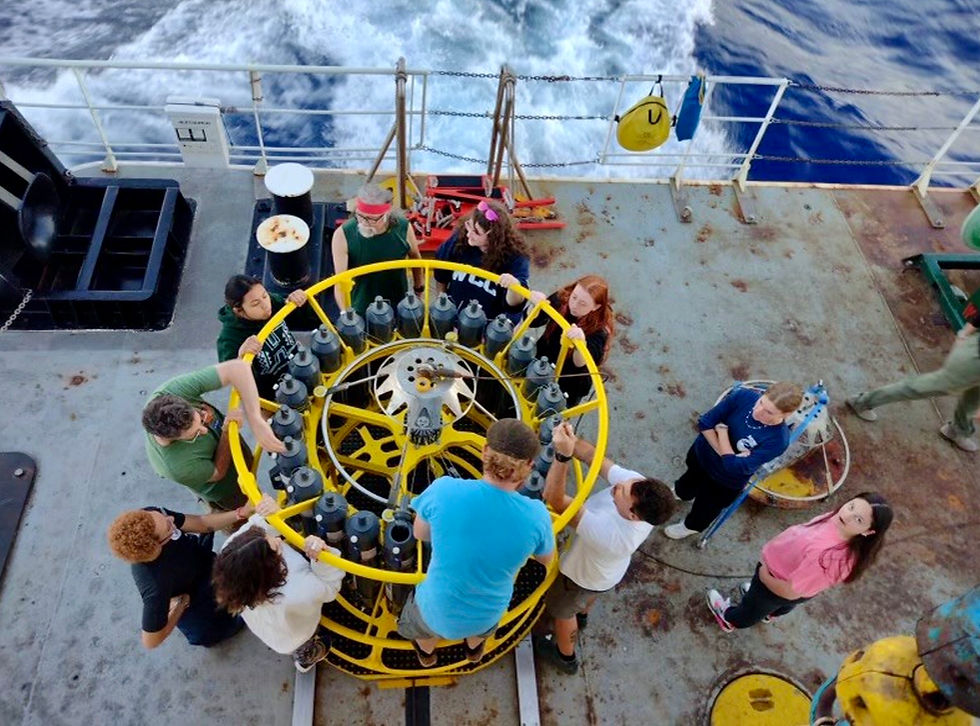
Long before CTDs (conductivity, temperature, and depth-measuring electronic packages) hummed their way through the water column, logging thousands of data points per second, mapping entire water masses in the time it takes to brew a pot of coffee, there was the Niskin bottle.
A simple cylinder. Two spring-loaded caps. A length of line or wire. And, if you were lucky, a small brass (or lead) “messenger” that felt like a talisman in your hand.
For many of us, this was oceanography’s first rite of passage: plotting a course by hand, checking the depth sounder, spooling out line or cable with a mix of anticipation and mild seasickness, and lowering a weighted Niskin bottle into the great blue quiet.

There was a kind of alchemy in building your first Niskin bottle—a simple segment of PVC pipe reborn as oceanographic instrument through equal parts curiosity and hardware-store ingenuity. You threaded a bungee cord down its center, knotted rubber toilet-plunger heads onto each end, and marveled at how this unlikely trio could become a watertight sampler. Relax the bungee, and the plungers sealed with satisfying certainty; stretch it up and over the tube, and the whole device opened itself to the sea.
The art was in the tensioning—tight enough to hold, but not so jumpy that it snapped shut at the slightest shudder of the line. Only the descending messenger, that tiny metal envoy, was worthy of triggering the seal. The ritual of tuning and testing—stretch, release, curse, adjust, try again—held its own quiet exhilaration. In those moments, you felt the first real steps into science take root: an intoxicating blend of patience, problem-solving, and the wonder of coaxing a simple homemade device into revealing the ocean’s secrets.
It was elegant in its simplicity. And it taught us more than we realized.
Lowering a Bottle, Gathering a Whole World
Back in the day, sampling wasn’t just a procedure, it was choreography. You lowered the bottle down to 10 meters. Then 30. Then 100. Each meter earned, not assumed.
Once the bottle reached your target depth, you clipped on the messenger—a small metal weight—and watched it slide down the line, disappearing into the murk. You counted the seconds, not because you needed to, but because the sea demanded a bit of ceremony.
Clack.
Somewhere below the surface, the messenger struck the bottle’s trigger. The caps snapped shut, sealing in the exact water that existed at that exact place, at that exact moment in time. All this action transmitted as a tremor up the line and into your hand.
And when you hauled the bottle back up and unlatched the caps, the ocean’s secrets spilled into sample jars, your choreography quickening to capture time-sensitive data before it was lost: temperature, salinity, oxygen, nutrients, turbidity, chlorophyll, bacteria—worlds within worlds, all suspended in a liter of water.
This wasn’t just data. It was intimacy. A handshake with the sea.
Again. And Again. And Again.
Oceanography once meant repetition, not because we lacked imagination, but because our tools were limited and the ocean demanded that kind of devotion. You didn’t take a vertical profile of the water column. You built one. One depth at a time.
As the day went on, you learned the ship’s roll. You learned how to move and work aboard a rocking vessel. If you were so lucky as to have a winch on board, you learned the quirks of the winch operator. You learned that even the calmest-looking sea hides a thousand moods.
And you learned patience; the kind that tells you science is not a single triumph but a series of tiny, careful acts.
What We Gained With CTDs
Then the modern CTD arrived. Suddenly, a task that took hours—or a day—now took minutes. Sensors provided continuous profiles: Temperature. Salinity. Dissolved oxygen. PAR. Fluorometry. pH. Turbidity. Backscatter. And more.
Instead of a dozen data points, we had tens of thousands. Instead of sending down one Niskin at a time, CTD rosettes carried 12, 24, even 36 bottles in a single cast.
With CTDs, oceanography gained an entirely new way of seeing. Suddenly, fine-scale structure that once hid between sampling depths came into view with astonishing resolution. Efficiency followed: hours once spent lowering bottles and logging readings gave way to deeper analysis, clearer interpretation, and more thoughtful synthesis. There was added safety too, with fewer long, precarious shifts spent leaning over railings in rough seas. And perhaps most transformative of all, CTDs expanded our breadth of understanding, allowing us to track whole oceanographic events instead of catching only fleeting, depth-by-depth glimpses.
We gained speed, accuracy, productivity, and an entire generation of discoveries that were simply impossible before. The CTD is brilliant. Transformative. No question.
But What Did We Lose?

Permit us a brief Abe Simpson moment to yell at some clouds: somewhere in the hum of modern sensors and the clean lines of digital plots, we lost something too—something less tangible, but not less real. We lost the slow apprenticeship of field observation. We lost the repetitive muscle memory that taught us the vertical structure of the sea not through graphs, but through experience.
We lost the ritual: the lowering, the waiting, the messenger dropping like a prayer, the clack echoing through the line. And most of all, we lost the intimacy of touching the ocean—literally in our hands—one bottle at a time.
CTDs give us information. Niskins gave us relationship.
Maybe the Future Needs Both
Modern oceanography depends on automation. It must. The scale of change—warming, acidification, deoxygenation, shifting currents—demands tools that can capture entire basins at once.
But the old ways still have something to teach. A Niskin bottle reminds us that the ocean is not just a dataset. It is a place, a presence, and a partner in the work.
There’s value in assembling a simple device that costs 30 bucks in raw materials from the hardware store and still does—beautifully—what no algorithm can: gather a moment in the sea, untouched, uncompressed, unabstracted.

And there’s beauty and power in getting more hands-on, not less. Take the Open CTD Project from Oceanography for Everyone. It starts with a simple belief: the ocean belongs to everyone, and the tools to study it should too. The OpenCTD—a low-cost, open-source version of oceanography’s core instrument—is built from easily sourced hardware/electronics store components and assembled by the end-user.
That do-it-yourself approach gives scientists, educators, and community researchers not only access to essential data but also the skills to maintain, repair, and adapt their own equipment. For remote fieldwork, it prevents small failures from becoming project-ending setbacks; for students, it opens the door to coding, 3D printing, and hands-on STEM. In making a CTD that anyone can build, the project is democratizing ocean science one sensor at a time.
Maybe the lesson is this: The ocean’s future will be mapped by satellites, gliders, and autonomous sensors, but it will be understood and navigated by the sort of people who once listened for the clack of a messenger hitting a Niskin bottle on a quiet sea, learning patience and humility one cast at a time. And even as AI helps us sift patterns from the data, it will still take human insight to turn those patterns into meaning.
The old bottles still have wisdom in them.
And so do the stories of those who lowered them through the water column—again, and again, and again.


Comments