Turn the Animal Over

What Hallucigenia, Stephen Jay Gould, and 500 million years of evolutionary history can teach us about what we stand to lose

There may be no animal in the history of paleontology that has benefited more from being turned over.


When paleontologist Simon Conway Morris reconstructed Hallucigenia sparsa in 1977, the tiny Burgess Shale creature seemed to walk on seven pairs of rigid spines. A row of soft tentacles waved from its back. At one end, an indistinct bulb served—perhaps—as a head. It was less an animal than an evolutionary fever dream, so alien that even its name announced disbelief.
Stephen Jay Gould loved it.

In Wonderful Life, his brilliant 1989 meditation on the Burgess Shale and the nature of history, Hallucigenia joined Opabinia, Wiwaxia, and other “weird wonders” as evidence for a radical vision of the Cambrian seas. Gould argued that early animal life contained a profusion of fundamentally different anatomical designs—more disparity, in his telling, than exists today. Most were subsequently extinguished over geologic time, not because they were inferior, but because history is contingent. Rewind the tape of life, let it play again, and entirely different survivors might inherit the Earth. Humans, Gould famously insisted, were no inevitable destination.
On that last point, Gould was surely right. Evolution has no foresight, no ladder, and no appointment with us waiting at the top.
But Hallucigenia was standing on its back.
The Seduction of the Wonderfully Strange

In 1991, Lars Ramsköld and Hou Xianguang proposed turning the animal over. The “tentacles” became paired walking legs; the rigid “legs” became defensive spines along its back. Later work revealed the second row of legs, claws, simple eyes, and a mouth and throat armed with tiny teeth. What had looked like an unclassifiable oddity came increasingly into focus as a lobopodian—a stem relative within the lineage that includes velvet worms, tardigrades, and arthropods.
It remained wonderfully strange. It just wasn’t unrelated.

This was not a story of an obvious truth ignored by careless scientists. Unlike the bones of dinosaurs or bony fish, soft bodies rarely fossilize with their anatomy cleanly intact. Burgess Shale organisms survive largely as flattened films in rock, compressed by sediment after burial. As their tissues decomposed and were compressed, organic material could spread beyond the body, leaving stains that resemble anatomical structures—or obscuring structures that were actually there. Interpreting such fossils means distinguishing legs, spines, and organs from the chemical shadows of decay. Hallucigenia did not arrive with “this side up” stamped beneath it. And once the evidence changed, Gould accepted the revised orientation.
Still, Hallucigenia exposes a hazard that reaches beyond one fossil reconstruction. Gould was so committed to preserving the radical otherness of the Burgess Shale fauna that attempts to place its animals near familiar groups could look to him like “shoehorning”—forcing the past into categories derived from the present. Sometimes that warning was justified. The history of paleontology is crowded with genuinely unfamiliar organisms pressed too quickly into ill-fitting modern boxes.
But there is an equal and opposite danger: mistaking our failure to recognize a relationship for evidence that no relationship exists.
Strangeness can become seductive. Once an animal has been cast as an evolutionary orphan, every unfamiliar feature reinforces the story. A spine becomes a stilt. A leg becomes a tentacle. Ambiguity begins to look like proof of alienness. The reconstruction and the thesis hold each other upright—until someone turns the fossil over.
Not Shoehorned, But Situated
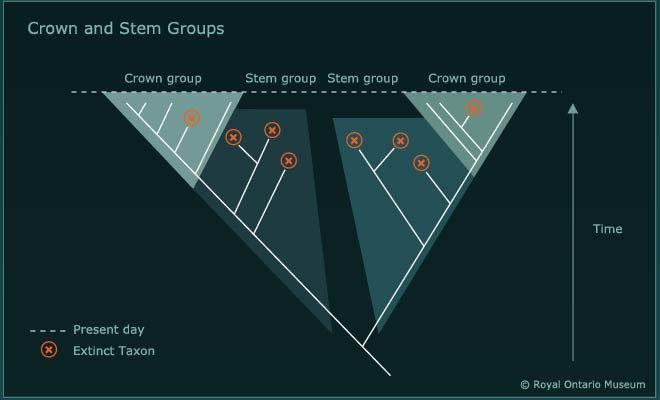
Much has changed since Wonderful Life was published. New fossils, new imaging methods, and especially the widespread use of cladistics have redrawn the Burgess Shale family portrait. Most of Gould’s “weird wonders” are no longer regarded as representatives of separate, wholly extinct phyla. Instead, they can now be situated, with varying degrees of confidence, along the stems of living groups.
This does not make them primitive versions of modern animals, unfinished drafts waiting to become something recognizable. A stem-group animal is not necessarily the ancestor of anything alive today. It is an extinct branch that separated before the last common ancestor of a living group acquired all the features that define its crown. Stem groups are evolutionary cousins, not crude prototypes.
Seen this way, the Cambrian fossil record becomes neither a museum of failed experiments nor a sudden unveiling of fully assembled modern body plans. It shows bodies being built. Features that now arrive as a package appear in unexpected combinations: some ancestral, some specialized, some destined to persist, and others lost forever. The tree of animal life had already divided into many of its deepest branches, but those branches were still producing forms far outside the range occupied by their living descendants.
That is not a retreat from wonder. It is a more intelligible kind of wonder.
To call Hallucigenia a stem onychophoran does not domesticate it. It connects its paired claws, soft legs, dorsal spines, and tooth-lined throat to a history that extends into the living world. Classification here is not a box dropped over the animal. It is a hypothesis about relationship—an attempt to recover kinship across more than half a billion years.
And kinship may be the more powerful story.
What If the Tape Has Grooves?
Gould’s metaphor of replaying life’s tape remains irresistible because it attacks one of our most persistent conceits: that the past was somehow trying to produce the present. Change one extinction, one climate shift, one lucky survival, and there is no reason to expect Homo sapiens to appear again.
But contingency need not carry all the explanatory weight Gould placed upon it. Evolution is historical, yet it is not infinitely plastic. Organisms inherit bodies, genes, developmental pathways, and ecological relationships. Physics limits what can swim, burrow, see, grasp, and feed. Similar problems can repeatedly call forth similar solutions. History branches, but it branches from somewhere.
Perhaps the tape of life is neither a predetermined score nor a recording of pure improvisation. Perhaps it has grooves: inherited pathways deep enough to channel what comes next without dictating exactly where any lineage will end. Genes and developmental systems inherited from ancestors make some variations more readily available than others; physics and natural selection further limit which forms can function and persist. Together, these influences make some routes through morphospace—the range of forms life might take—more accessible than others, even if our maps of that space remain partial and provisional. Understanding how inherited developmental pathways both enable and constrain that exploration has become a central concern of evolutionary developmental biology, or evo-devo.
That picture leaves ample room for contingency. The particular branches that survive still matter enormously. So do asteroid impacts, anoxic seas, shifting continents, evolutionary innovations, and plain bad luck. But the reclassification of Burgess Shale animals suggests that contingency operated within a history of accumulating structure. The Cambrian did not simply generate a carnival of disconnected body plans and then eliminate most of them at random. It established—and continued to elaborate—many of the deep lineages within which animal life still unfolds.
If Gould’s forest was repeatedly clear-cut until only a few arbitrary trees remained, the newer view looks more like an ancient, branching watershed. Channels split, rejoin, deepen, and disappear. Some routes become impossible once water has gone another way. What reaches us today is not inevitable, but neither is it without continuity.
There Is No Replay Button
Do we lose anything if contingency was not as dominant as Gould envisioned?

We lose a certain dramatic image of the Cambrian: a vanished menagerie of entire alternative worlds, almost wholly severed from our own. We may also lose some of the rhetorical force of the claim that survival is radically unpredictable and that evolutionary success reveals little about inherent superiority.
But we gain something at least as consequential.
We gain a clearer view of living animals as the present tips of immensely old experiments. Arthropods, mollusks, annelids, echinoderms, chordates, sponges, and cnidarians are not recent tenants occupying ecological roles that life can readily refill. Their deepest histories reach toward the dawn of complex animal ecosystems. Their modern forms are the latest expressions of lineages that have survived continental rearrangements, climate upheavals, ocean anoxia, and mass extinction.
That endurance can create a dangerous illusion. A lineage that has persisted for hundreds of millions of years can seem effectively indestructible. But deep time does not confer immunity. It only records survival up to now.
Nor does the survival of a phylum make the loss of its constituent species inconsequential. We do not conserve abstract branches on a diagram. We conserve living populations, ecological functions, evolutionary potential, and relationships that exist nowhere else. A coral lineage may be ancient; a particular reef still can die in a human lifetime. Sharks have endured multiple mass extinctions; that does not make an overfished population replaceable. A species lost from the tip of an old branch is not restored because distant cousins remain.
Extinction prunes more than the present. It removes a singular accumulation of history and forecloses every future that lineage might have produced.
This is where the reinterpretation of the Burgess Shale acquires moral force. The strange creatures in those rocks are not less important because many can now be placed near living phyla. They are more intimate. They show how much anatomical possibility once flourished along branches that still reach into our seas—and how much of that possibility has already been cut away.
Gould asked us to imagine rewinding the tape. Conservation asks us to face the opposite reality: there is no rewind.
Once a lineage is gone, evolution does not retrieve it from the archive. Another species may eventually occupy a similar niche or arrive at a similar shape. That is not resurrection. Convergence can rhyme with what was lost, but it cannot restore the same history, relationships, or unrealized future.
Turn the Animal Over
Wonderful Life endures because Gould understood that fossils are not merely old objects. They are arguments about what history means. His insistence on contingency helped free evolutionary thought from the comforting fiction of inevitability. It made room for accident, extinction, and humility. Even where later evidence revised his Burgess Shale taxonomy, the larger provocation remains alive.
But humility must cut both ways. We should resist forcing unfamiliar fossils into familiar categories. We should also resist making unfamiliarity itself the conclusion. Sometimes the oddest creature in the room is not an evolutionary alien. It is family seen from an angle we have not learned to recognize.
Turning Hallucigenia over did not make the Cambrian less wonderful. It revealed something more profound than isolation: continuity without inevitability. The animal was strange, but not alone. Its body carried clues to a shared inheritance that still animates velvet worms, water bears, arthropods, and the larger molting-animal clan today.
Perhaps that is the deeper lesson in the stone. Life did not have to arrive here. But the life that did arrive carries an inheritance billions of years in the making, assembled through branches that cannot simply be regrown once severed.
The history of life is not precious because every outcome was a cosmic accident. It is precious because every living lineage is both survivor and possibility: an unrepeatable past still making a future.
And for the branches now in our hands, there is no turning the animal over again.


Comments